
Mark Harris
Mark Harris is an award winning artist, activist and educator. He has combined his passions for art making and activism to create visually compelling work that he uses to engage his audience on issues facing society today. He has established a strong independent voice and is one of the San Francisco Bay Area’s most controversial artists. The Metro Silicon Valley News called his work “brilliantly subversive.”
His evocative, elegant and dynamic creations have caught the eye of international and domestic art collectors alike. A native of Durham, N.C. Harris grew up in Atlanta, Georgia, but he now lives and works in San Francisco, California.

Photo by Marcus Badgley
Artwork Gallery


1. “To Be Young, Gifted and Criminalized,” mixed media on paper, 16"x24", 2014
Reflection Questions:
How are Black children perceived?
What is the reality?
How do people's expectations shape outcomes?
2. “I Too Am America,” mixed media on panel, 21"x16", 2016
Reflection Questions:
Compare the public reaction to the death of a Black child and a white one.
What is the emotional impact on children in high-crime neighborhoods?
3. “Tuned Out,” 30"x24", mixed media on panel, 2015
Reflection Questions:
What are some realities you'd like to tune out from?
What is the personal cost of tuning out, and the cost to others?
4. “Pride and Prejudice,” 40"x30", mixed media on panel, 2015
Reflection Questions:
What emotions do these images evoke?
How do the images speak to different aspects of U.S. history and our current times?
5. “Den of Iniquity,” 20"x20", mixed media on panel, 2016
Reflection Questions:
What images from the top half of this artwork stand out to you?
How does the scene at the top connect to the scene below it?
6. “In Guns We Trust,” 30"x24", mixed media, acrylic paint, acrylic ink, archival photo paper, and vinyl, 2015
Reflection Questions:
What emotions does this image spark?
How does gun violence impact some communities more than others?
How does it impact all of us?
7. “Immigration Theory,” 24"x30", mixed media collage on panel, 2016
Reflection Questions:
Which Americans are not descended from immigrants?
Are immigrants from Europe, Asia, Latin America, and SWANA countries treated equally?
If not, why not?
8. “Think Black Thoughts No 1,” 16"x20", mixed media on panel, 2021
Reflection Questions:
What would "decolonizing the mind" look like for you?
What assumptions would you need to let go of?
What would you need to learn more about?
Over and Over Again: The Art of Becoming
Creating art has given me comfort and a sense of identity since an early age; it’s how I process the world. The people, places, and events that move me deeply are what fuel my work. As an artist, I want to fully explore and express my emotions in response to these influences, not just illustrate them.
I remember one afternoon when I was seven, handing my dad a blank sheet of paper and asking him to draw a horse. He produced something that looked more like a refrigerator on stilts than anything that ever ran in a pasture. I told him so. “Find a picture you like, and draw it until you get it right,” he said.
That moment sparked my lifelong interest in creativity; in essence, it was my first real lesson in art and persistence. I’d sit for hours, tongue clenched in concentration, copying the curve of a horse’s neck over, and over, and over again. After horses came athletes, then hot rods, then superheroes in capes. I chased whatever caught my eye, filling page after page.
But growing up has a way of crowding out those quiet hours. By my late teens, I’d traded sketchbooks for driving, dating, and part-time jobs. After high school and a brief stint in junior college, I bounced through corporate gigs in and around Atlanta for five years. A creeping sense grew that I was letting something important slip away. In 1996, the urge to create started to gnaw at me again, so I enrolled at the Art Institute of Atlanta, squeezing in classes between work shifts. As work became more demanding and I moved up, art school’s structure felt limiting. At the end of 1996, I was offered a promotion and a move to Tampa, complete with a raise and moving expenses. I jumped at the chance and dropped out, leaving school behind and throwing myself into the financial printing industry. Three and a half years later, I transferred to a new company in the same field, this time in Palo Alto, California. Each new paycheck dulled my hunger for more, but the feeling never left me: this wasn’t it. I was restless, haunted by the memory of that kid at the kitchen table, drawing horses just because he wanted to.
Then came the meeting. Spring 2001, a stuffy conference room, my boss and an HR manager across a polished table. “Dot-com bubble’s bursting,” they said. “Take a $20,000 pay cut and stay, or two weeks’ severance and go.” They gave me a day to decide, but I knew before I left the room. I wasn’t going to trade my time for a life I didn’t want—especially not for less money.
So I quit. For the first time in years, I felt a strange, exhilarating panic. I had no master plan—just a journal where I wrote, in shaky handwriting, the kind of artist I wanted to become. I started painting every day—no excuses, no turning back. I chased the feeling I had as a child: curiosity, excitement, the thrill of seeing something new take shape under my hands.
Twenty-five years later, I’m still at it. My work is a visual diary—a record of my life as a Black man in America, stitched together from the things that move me: people, places, moments of joy and anger.
In 2014, after Michael Brown’s murder and the unrest in Ferguson, my work shifted. The news felt like a punch to the chest—sudden, breath-stealing. I poured my outrage and grief into my art, tackling themes of police violence and white supremacy, searching for ways to disrupt the easy narratives people cling to. I started blending photo collage, painting, and bits of old advertisements—using familiar images in unfamiliar ways, hoping to make viewers stop and look again.
These days, every finished piece feels like a small act of resistance, a way of insisting on my own perspective. Sometimes, at gallery shows, I watch people pause in front of my work—lean in, step back, frown, laugh, ask questions. That’s the moment I live for: when the art makes someone see the world, even briefly, through my eyes.
We’re living in a time when everything feels up for grabs. I don’t have answers, but I believe in the power of art to shake things loose—to help us imagine something better. That’s what keeps me coming back to the canvas, day after day, over, and over, and over again.
Video. After reading about the removal of Mark Harris’ artwork from the lobby of the administrative offices of the East Side Union High School District in San Jose, the San Francisco Museum of Modern Art reached out to him to see if he would be interested in ruminating on what it means to be working in public spaces, and how he sees the role of the artist as public intellectual in society today. Here is his video response:
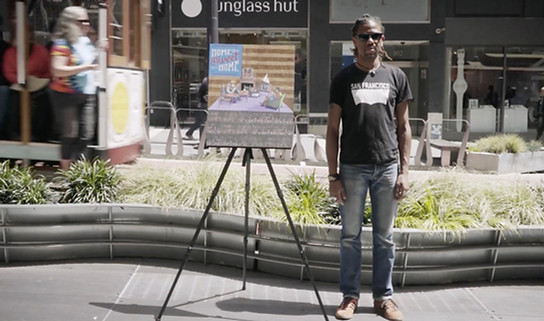
Reflection Questions:
What ideas or feelings does Mark Harris's video "State of Denial" evoke for you about America's legacy of racism?
What does visibility mean for artists, especially Black artists in the U.S.?